REVIEW · DUBLIN
The Dublin Private Walking Tour
Book on Viator →Operated by Travelling Ireland · Bookable on Viator
Music street stops in three focused hours. This private Dublin walking tour threads together famous landmarks and Ireland’s cultural story, from Claddagh Records and the Wall of Fame to Trinity College and Merrion Square. I especially like the way the guide keeps things personal for your group, and how the route hits music, politics, and everyday Dublin life without turning into a textbook. You’ll likely be happiest with good shoes, because it’s a steady walk with lots of short stop-and-look moments.
What really makes this tour work is the human touch. Guides such as Pasquale, Conor, and Sharon are repeatedly praised for pacing, friendly humor, and room for questions, so you’re not just hearing facts—you’re getting context and local pointers like where to eat, drink, and linger. A possible drawback: the pace fits an adult rhythm more easily than very young kids, so families with toddlers may want to plan for breaks and shorter attention spans.
Key things to know before you go
- Private by design: it’s your group only, so the guide can slow down or speed up.
- Music-to-politics route: U2, Phil Lynott, and other Irish icons show up, then the walk turns to government sites.
- Free-to-view stops: the listed highlights are marked as free, so you’re not constantly paying entry fees.
- Built-in photo time: the guide will help with photo opportunities at key corners and monuments.
- Weather help: umbrellas are provided, plus there are rest/toilet breaks if you need them.
- End in a classic finishing spot: you close near Oscar Wilde in Merrion Square, a great launch point for your next plan.
In This Review
- Entering Dublin Through Temple Bar’s Music Trail
- The Liffey Crossing and College Green Power Views
- Molly Malone to Grafton Street: Fun History on Foot
- The Great Famine Memorial and Georgian Government Sites
- Leinster House to Oscar Wilde: Closing on Culture
- The Guide Factor: How Private Pacing Changes Everything
- Price and Value: What $163.26 Buys You
- Practical Tips for a Smooth 3-Hour Walk
- Should You Book This Dublin Private Walking Tour?
- FAQ
- How long is the Dublin Private Walking Tour?
- Is this a private tour or a shared group?
- What language is the tour offered in?
- Where does the tour start and where does it end?
- Are umbrellas provided for the walk?
- Are there rest or toilet breaks?
- Is admission included for the stops?
- What is the cancellation policy?
Entering Dublin Through Temple Bar’s Music Trail
If you start your first trip to Dublin with Temple Bar, you’re not choosing the calm option. You’re choosing the loud one—full of history, characters, and music energy—and that’s exactly why this tour starts here.
You meet at Travelling Ireland’s Dublin location on Cecilia St, right in Temple Bar. From the first minutes, the guide sets the tone: you’re walking through Dublin like a storybook, but one with real street-level details. And because it’s private, you can ask small questions early—how neighborhoods differ, what to pair with a pub visit, and which sights make sense on the same day.
Stop 1 is Claddagh Records, a quick but memorable introduction to Ireland through music culture. You’ll also connect the famous Claddagh ring to the broader idea of Irish identity and symbolism. It’s only about ten minutes, but it helps orient you for the rest of the walk: this city wears its stories on the outside.
Stop 2 is the Wall of Fame, where famous Irish bands and singers are named and celebrated—U2, Phil Lynott, Van Morrison, Sinéad O’Connor, and The Cranberries. It’s a fast stop, but it works because it anchors later history. When you move from music to politics, you can feel how culture and national identity overlap here.
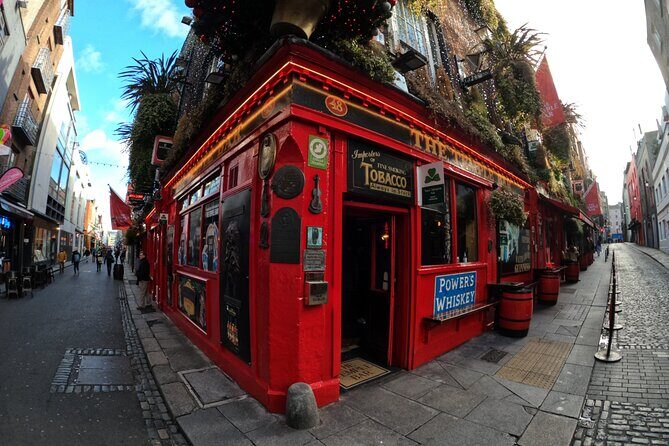
Stop 3 brings you into the Temple Bar pub area itself, including the famous cobblestoned streets. The Temple Bar pub is noted as established in 1840, and the guide helps you understand why this corner became such a magnet. The main drawback in this zone is simple: Temple Bar can be busy and noisy, so if you’re sensitive to crowds, choose times of day when you can hear the guide clearly and still enjoy the streets.
The Liffey Crossing and College Green Power Views
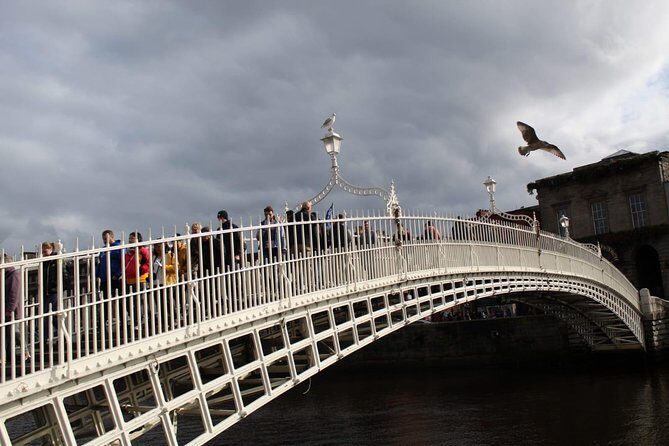
After Temple Bar, the walk shifts into postcard Dublin, with a river crossing that’s both iconic and full of social meaning. Stop 4 is Ha’penny Bridge, where you’ll look at the bridge’s historic details and also talk about the River Liffey and Dublin’s socioeconomic story. It’s one of those sights that’s easy to photograph, but richer when someone explains why the crossing mattered in daily life.
Then you head into Stop 5: College Green. This three-sided plaza is surrounded by big-name buildings and big ideas. You’ll see the Bank of Ireland building, which until 1800 was Ireland’s Parliament House, and you’ll connect that to Trinity College Dublin standing nearby. To the south are 19th-century buildings, giving you a sense of how Dublin layers eras in one view. The practical value here is that you’ll start seeing the city as an arrangement of power, education, and influence—not random landmarks.
Stop 6 is Trinity College Dublin. You get the chance to stroll the campus and get a feel for it as Ireland’s oldest college. For many visitors, the Trinity stop is where Dublin becomes less about street scenes and more about institutions—who learned here, what the campus represents now, and how it shapes the city’s daily rhythm. The main consideration: even when entry is free for your route, campus spaces can still feel crowded on peak days, so it’s nice to go with a guide who knows how to keep you moving.
You can also read our reviews of more walking tours in Dublin



Molly Malone to Grafton Street: Fun History on Foot
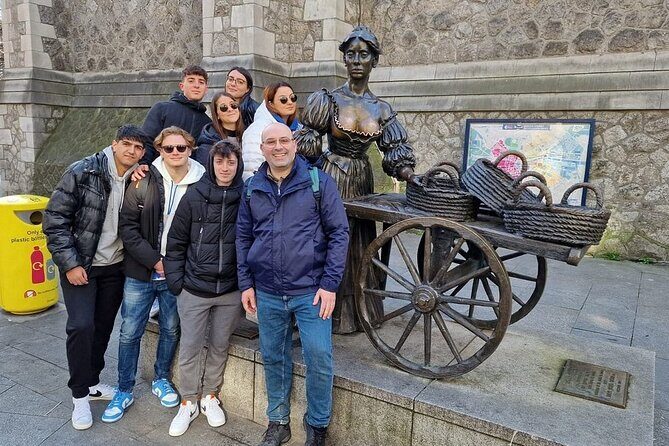
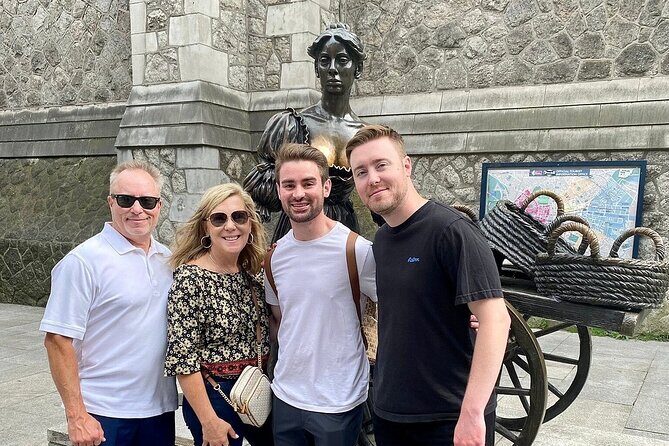
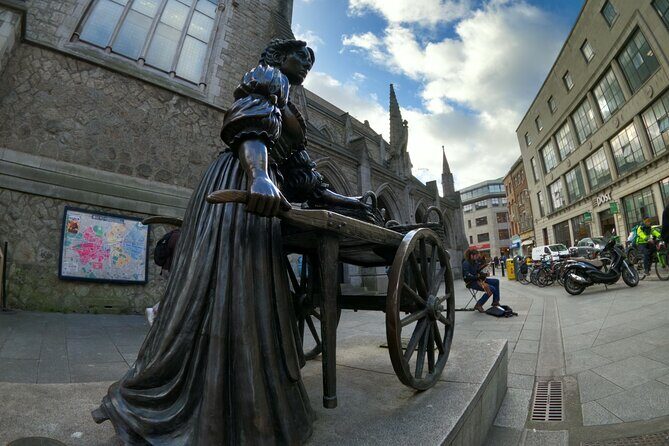
Now the tour turns lighter, with stories you’ll actually want to repeat at dinner. Stop 7 is the Molly Malone statue, tied to Molly’s folklore and the famous Dubliners song. You’ll also note St. Andrew’s church in the area, which adds a grounded sense of place around the myth. This is a short stop, but it’s the kind you remember because it blends a catchy cultural reference with real street geography.
Stop 8 is Grafton Street. This is where Dublin feels like a living street, not a museum. The walk includes the fact that it’s one of Europe’s busiest shopping streets, with Brown Thomas in the mix for luxury shopping. What changes the tone here is the daily flow of street performers—musicians and poets—so the guide can point out what to watch for and how to fit it into your day without getting trapped in tourist-only lanes.
At the top of Grafton Street, you transition to Stop 9: St Stephen’s Green. This central park stop is designed for a breather. You’ll walk through the green space and spot wildlife like swans and ducks, which gives you a break from built-up streets. The drawback is weather-related and seasonal: parks can get muddy in wet stretches, and crowded times can limit how quietly you can enjoy the walk. Still, it’s a smart reset point, especially after the busier shopping streets.
The Great Famine Memorial and Georgian Government Sites
This part of the tour gets more serious, and that’s a good thing. Dublin’s story isn’t only pubs and songs—it also includes survival, political change, and public memory.
Stop 10 is Edward Delaney’s Famine Memorial. The sculpture shows thin, struggling figures meant to represent hunger and hardship. The value of this stop is clarity: it gives you a visual way to understand the Irish Great Famine without forcing you to sit through a lecture. It’s also a reminder that Dublin’s landmarks have emotional weight. If you’re traveling with kids, I’d suggest telling the guide ahead of time so they can pitch the story in a kid-appropriate way.
Stop 11 is the Theobald Wolfe Tone statue, associated with Irish Republicanism. You’ll find it in front of the Shelbourne Hotel, and the guide can help connect why that figure matters in Irish political history. If politics isn’t your thing, you can still enjoy this as public art tied to a real person and a real place.
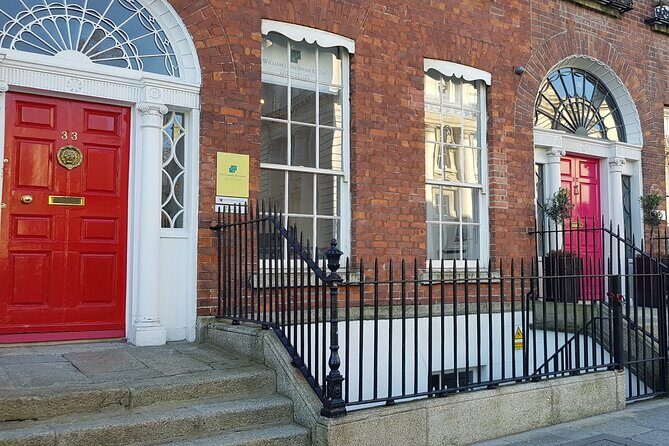
Stop 12 is the Department of the Taoiseach, where you focus on Georgian architecture and the feel of government buildings in central Dublin. This is one of those stops that makes sense when you look at it like a map of how the city governs itself. It’s also a quick one (around ten minutes), so it won’t drag your morning.
Leinster House to Oscar Wilde: Closing on Culture
By the time you reach Stop 13 and 14, you’ll see a nice full circle between public life and creative life.
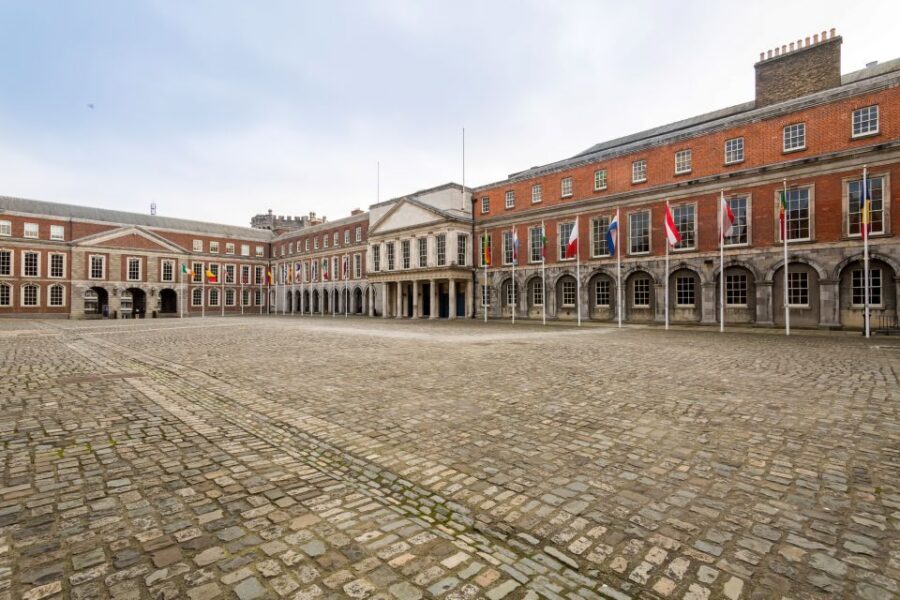
Stop 13 is Leinster House. You’ll learn it was once the ducal residence of the Duke of Leinster, and since 1922 it has served as the parliament building of the Irish Free State. Even if you don’t go inside, the surrounding context helps you grasp how political buildings occupy the city’s core. It can feel formal, but it also makes Dublin’s story easier to follow: education and art on one side, governance and national identity on the other.
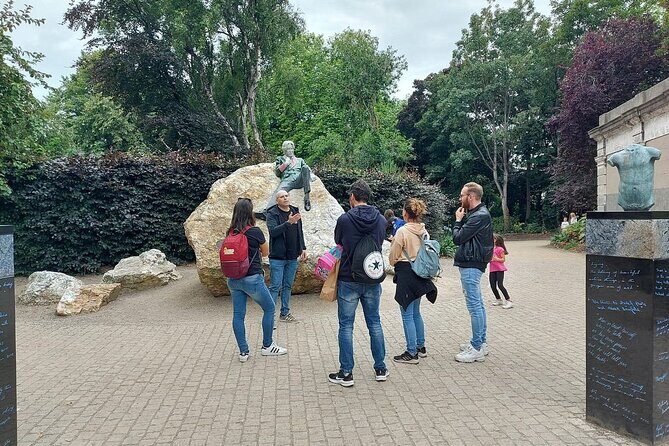
Stop 14 is the Monument to Oscar Wilde in Merrion Square. Here you get the literary Dublin angle, plus a link to Wilde’s 18th-century home. The tour ends at Merrion Square North, which is a great practical finish: you’re near a beautiful Georgian-designed area, and you can continue exploring on foot or link to public transport.
The Guide Factor: How Private Pacing Changes Everything
The biggest repeated win on this tour isn’t the route—it’s the guide. People consistently talk about warmth, friendliness, and a sense of humor that keeps the walk moving without rushing. I’d treat that as the main selling point, because it’s what makes the history easier to understand.
What I like most is that the guide can tailor the experience. You’ll notice it in how they pace you through short stops and still leave time for questions. Several guide styles show up in the same overall pattern: friendly conversation, clear explanations, and a willingness to adjust the plan based on what interests your group that day. If you’re the kind of traveler who hates a hard schedule, this matters.
Photo moments also feel built in, not accidental. You can expect help with picture opportunities at key monuments and corners, and it’s common for people to come away with a set of photos that actually captures the route. In some walks, you might even get a small surprise side stop—something like a quick swan sighting during the park portion—because the guide knows how to keep the tour human.
If your group includes families, the guide approach tends to stay flexible. One common praise point is that the guide manages to keep kids engaged even with a lot of walking. Just keep expectations realistic if you’re traveling with very small children; the tour is short in total time, but it still has multiple stop moments.
You can also read our reviews of more private tours in Dublin



Price and Value: What $163.26 Buys You
At $163.26 per person for a private 3-hour tour, the value comes from focus. You’re not paying for a ticket to a single museum. You’re paying for a guide who can connect dozens of small moments—music signs, statues, bridge details, campus atmosphere—into a storyline you can use immediately.
The other value driver is format: you get your group only, not a mixed crowd shuffling through landmarks. That privacy makes it easier to ask questions, take breaks, and adjust timing. You also get recommendations for restaurants, pubs, and shops, which can save you time later when you’re deciding where to eat and what to do next.
One more money-sense detail: many of the key stops in the route are marked as free to view, including Claddagh Records, the Wall of Fame, major bridges, and the public areas around the political and cultural buildings. That doesn’t mean everything in Dublin is free, but it does help keep this day from turning into a stack of fees.
If you’re considering alternatives, think about this way: a group tour might get you to the same general sights, but a private tour is better for your pace and your questions. The price makes sense when you want orientation plus context, not just photos.
Practical Tips for a Smooth 3-Hour Walk
This is an English-language walking tour offered with a range of departure times. Plan around your energy level and the weather. If it rains, you’re covered: umbrellas are provided. That’s not a small thing in Dublin, where a light shower can show up without warning.
In terms of timing, the route is built from short segments, typically around ten to fifteen minutes per stop. That’s good because it keeps you from sitting still. It also means you should treat the day like a purposeful stroll, not a relaxed wander where you can drift for long stretches.
Wear shoes you trust. Cobblestones show up near Temple Bar, and even outside the oldest streets, you’ll still spend time on uneven sidewalks and in public squares. If you’re the type who hates being on your feet, this might still be manageable, but you’ll want to lean on the included rest/toilet breaks and take them before you’re tired.
Also, use the tour as a planning tool. The guide will point you toward where to eat, drink, and explore. I’d leave your biggest plans for later in the trip, so you can return to the neighborhoods that feel right.
Should You Book This Dublin Private Walking Tour?
Book it if you want a smart first Dublin day that gives you bearings fast—especially if you care about Irish culture links across music and politics. The private format is the real edge here: you get a guide who can set the pace, answer questions, and keep the walk enjoyable from Temple Bar all the way to Oscar Wilde.
Skip it or shorten your expectations if you dislike walking, hate crowd zones like central Temple Bar and Grafton Street, or are traveling with very young kids who need frequent downtime. In that case, you might still enjoy it, but you’ll want a guide-led pace and a clear plan for breaks.
Overall, this tour is a good value when you treat it as orientation plus stories—not just a checklist of sights.
FAQ
How long is the Dublin Private Walking Tour?
The tour lasts about 3 hours.
Is this a private tour or a shared group?
It’s a private guided tour. Only your group participates.
What language is the tour offered in?
The tour is offered in English.
Where does the tour start and where does it end?
It starts at Travelling Ireland Viaggiare in Irlanda, 8 Cecilia St, Temple Bar, Dublin, and ends at the Oscar Wilde Monument in Merrion Square North, Dublin.
Are umbrellas provided for the walk?
Yes. Umbrellas are provided.
Are there rest or toilet breaks?
Yes. Rest/toilet breaks are available if needed.
Is admission included for the stops?
For the listed highlights in the route, admission is marked as free.
What is the cancellation policy?
Free cancellation is available up to 24 hours in advance for a full refund.