REVIEW · DUBLIN
Dublin: Bucket List Sights Walking Tour
Book on GetYourGuide →Operated by Yellow Umbrella Tours Ltd · Bookable on GetYourGuide
Dublin tells its story on foot. This 2-hour walking tour threads together Dublin’s big turning points, from early settlements to modern American influence, as you move through the city’s most famous landmarks. I like how it connects each stop to a clear chapter of the Dublin story, and I also like that the guide can answer questions and tailor the pace, like with Peter’s friendly, responsive style. One thing to consider: you’re covering a lot of ground in a short time, so comfy shoes really matter.
You’ll start at Christchurch Cathedral and work your way through St. Patrick’s, Dublin Castle, Temple Bar, and Trinity College, with stops designed to help you see why these places matter. I love that the tour points out specific details you’d miss on your own, like where Viking long boats tied up and how British rule ended in 1922. The potential drawback is that Temple Bar and the river crossings can feel crowded depending on the day, so expect a bit of shuffle time.
In This Review
- Key sights and what makes them work on this tour
- Getting oriented fast at Christchurch Cathedral
- Christchurch Cathedral: Vikings first, stone later, and Henry Roe’s money
- St. Patrick’s Cathedral and Jonathan Swift’s shadow
- Dubh Linn Garden and the Chester Beatty Library area
- Dublin Castle: layers of medieval and Georgian, plus independence in 1922
- Temple Bar: Tudor-era streets, live music energy, and pub culture
- Ha’Penny Bridge, Merchant’s Arch, and Central Plaza’s brutalist angle
- College Green and the government-and-finance vibe
- Molly Malone to Trinity College: finishing with Dublin’s most famous book
- Price and how $19 turns into real value
- Who this tour is perfect for
- Should you book this Dublin bucket list walking tour?
- FAQ
- How long is the Dublin Bucket List Sights Walking Tour?
- What is the price per person?
- Where do I meet the guide?
- How do I know I’m meeting the right guide?
- What sights are included?
- What language is the tour guide?
- Is this tour wheelchair accessible?
- Where does the tour end?
- Are there options for flexible booking?
Key sights and what makes them work on this tour
- Christchurch Cathedral: how Vikings, Normans, and later funding shaped what you see today
- St. Patrick’s Cathedral: Irish identity, plus a stop connected to Jonathan Swift
- Dublin Castle: a guided walk through medieval-and-Georgian layers tied to British rule and independence
- Temple Bar area: old streets from the Tudor Conquest, now famous for live music and pubs
- Ha’penny Bridge to College Green: great sightlines that connect the ancient city to newer Dublin
- Trinity College finish: Book of Kells exhibition location, ending with a big visual payoff
Getting oriented fast at Christchurch Cathedral
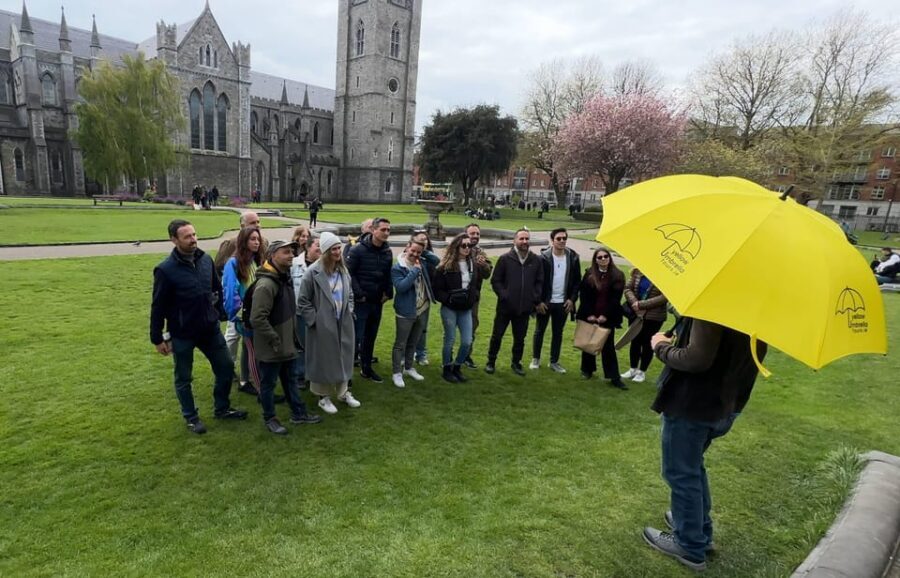
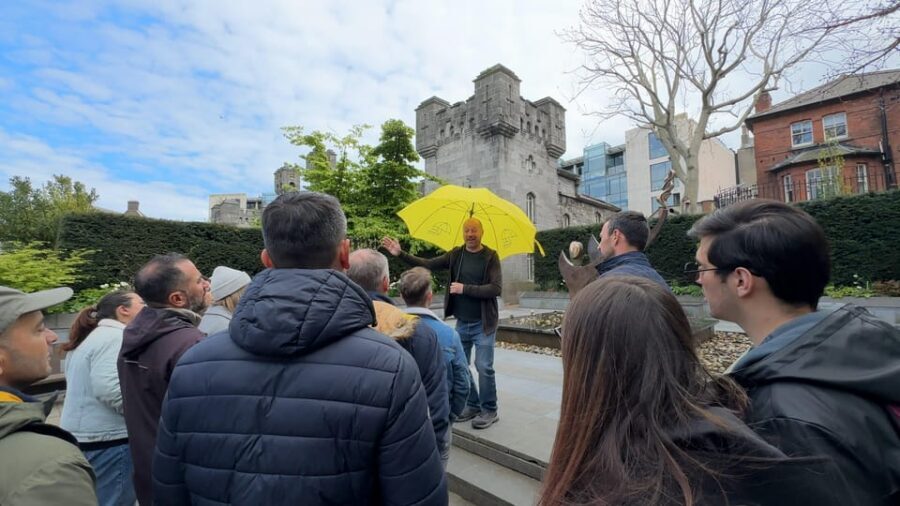
The tour starts by meeting your guide across the road from Christchurch Cathedral, outside the Bull and Castle. You’ll know you’re in the right place because the guide carries a yellow umbrella. This matters more than it sounds. Christchurch is a major landmark, so using a clear meeting spot helps you settle quickly and avoid that awkward first-search around a busy area.
From the start, you get the big picture. Dublin isn’t just a collection of pretty buildings. The tour frames the city as a timeline: settled by Celts around 2,100 years ago, then shaped by Christians, Vikings, Normans, English rule, and today’s American impact connected to the Silicon Docks. That structure helps you understand what you’re looking at, instead of just snapping photos and hoping it makes sense later.
In two hours, the goal is to give you momentum. You’ll see the headlines of Dublin’s story and leave knowing where to go next on your own.
You can also read our reviews of more walking tours in Dublin



Christchurch Cathedral: Vikings first, stone later, and Henry Roe’s money
Christchurch Cathedral is the first big stop for a reason. You’re looking at a building site layered with eras, and the tour explains how those layers got there. The cathedral’s story begins with the Vikings, who originally built something in wood roughly a thousand years ago. Later, the Normans recast it in stone, which is why the cathedral you see today feels more monumental and permanent.
Then comes the 19th-century twist. The tour highlights the role of Henry Roe’s whiskey money in shaping the spectacular 19th-century neogothic cathedral you see now. If you only knew Christchurch for its medieval roots, you might miss how Dublin’s wealth and patronage in later centuries still determined what survived into modern view.
Practical tip: Christchurch is an easy place to pause your attention. Spend a minute looking at the details the guide points out, then keep moving. The tour works like that—short stops, clear explanations, and then off to the next chapter.
St. Patrick’s Cathedral and Jonathan Swift’s shadow
Next up is St. Patrick’s Cathedral, named after Dublin’s patron saint. The tour connects the name to the legend of St. Patrick driving snakes off the island, which is a quick way to understand why this cathedral matters culturally, not just architecturally.
One of the most interesting pointers here is the connection to Jonathan Swift, including his burial place tied to the cathedral. Swift wrote Gulliver’s Travels, and the tour uses that link to make the site feel like more than a postcard. You’re not memorizing dates—you’re placing a person within a place that helped shape Irish public life.
The tour also notes that St. Patrick’s Cathedral was wonderfully restored in the 1860s thanks to the generosity of Sir Benjamin Lee Guinness. That’s helpful for you as a visitor because it explains why the building looks so cared for today. Restoration isn’t just maintenance; it’s a statement about what a community decided was worth preserving.
A small consideration: St. Patrick’s is a major stop, so if you’re sensitive to crowds, keep your head up for a moment and let the group flow. The guide’s pace helps.
Dubh Linn Garden and the Chester Beatty Library area
Between cathedrals and castles, the tour shifts to the area known as the Dubh Linn Garden. This is a smart transition because it grounds you in the place where earlier Dublin connected to the water.
The tour points out the site’s tie to the Chester Beatty Library and also the fact that Viking long boats moored there when they arrived in Dublin around twelve hundred years ago. That’s one of those details that makes walking feel physical. You’re not only looking at stone and roofs—you’re thinking about where people would have landed, unloaded, and started building.
If you’re a museum fan, the Chester Beatty connection gives you an easy next step. Even if you don’t enter on this tour, it’s the kind of location that can shape your day plan. You get a reason to return to the area later with more time.
Dublin Castle: layers of medieval and Georgian, plus independence in 1922
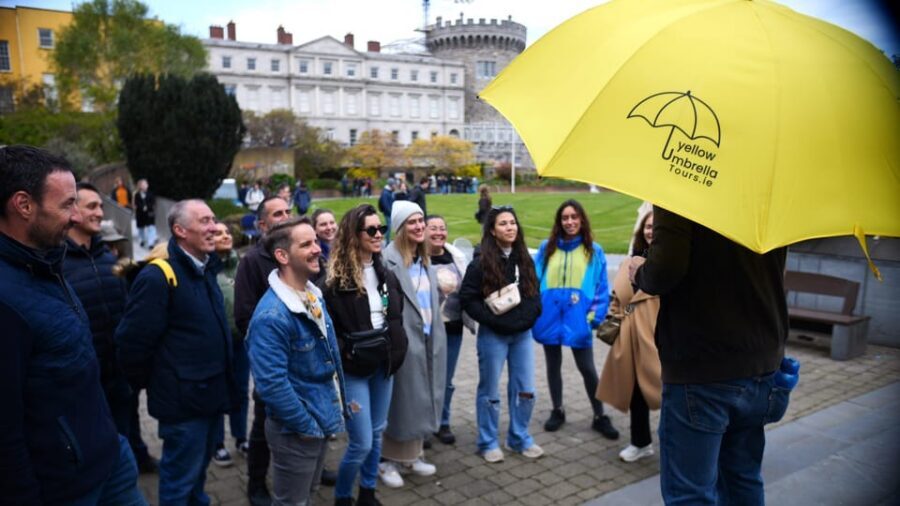
Then you hit Dublin Castle, and the tour treats it like the political heart it used to be. You move through both the lower and upper courtyards, and the guide calls out the mix of medieval and Georgian architecture. That blend is the point. Dublin Castle isn’t frozen in one era. It shows how different powers used, expanded, and redesigned the same core space.
Most important for your understanding: the tour frames the castle as the centre of British government in Ireland for about 700 years, until independence. It also gets specific about what happened in 1922, when the seat of rule was handed over to Michael Collins and the Irish Free State upon independence.
That detail makes the place feel less like a museum prop and more like a real turning point. You’re standing in a site that watched the transfer of power happen in real time for Irish history.
Practical note for you: courtyard architecture can look similar at first glance. So let the guide show you what to look for. When the guide points out contrasts between medieval sections and later Georgian touches, the whole place starts to read clearly.






Temple Bar: Tudor-era streets, live music energy, and pub culture
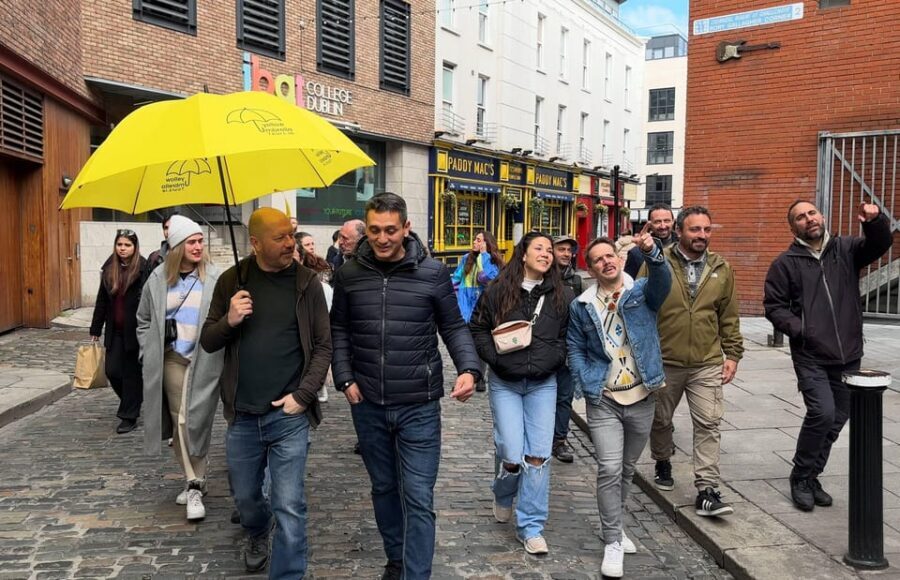
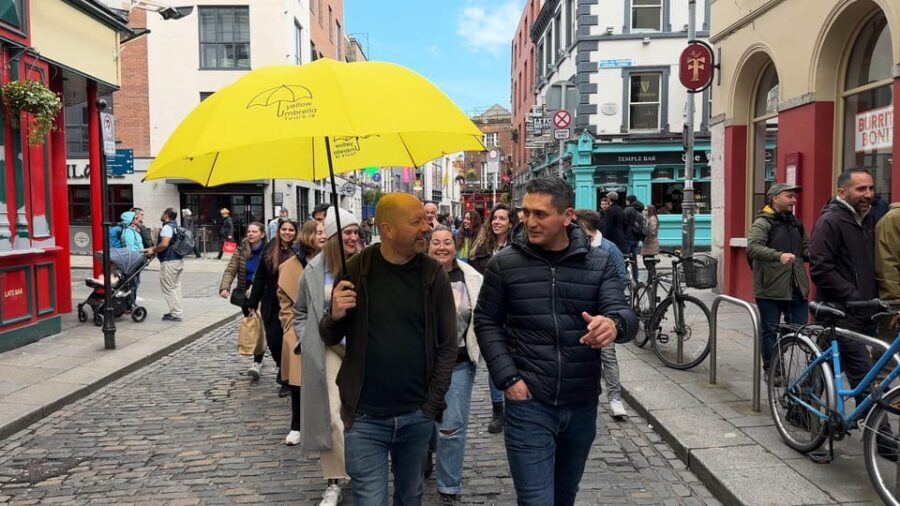
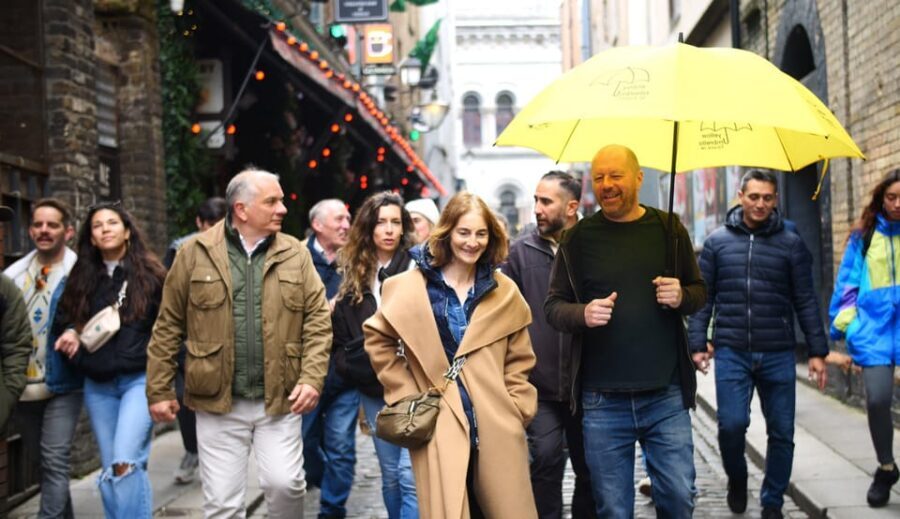
From the castle you head into the Temple Bar District. Here, the tour does something clever. It doesn’t treat Temple Bar as just nightlife. It explains that you’re looking at one of Dublin’s oldest parts, dating from the Tudor Conquest in the 16th century.
Then the tour brings it to the present day: Temple Bar is now famous for live music and lively Irish pubs. That combination matters. If you go on a self-walk, it’s easy to miss how the area’s age still shows through the streets. On this tour, you get the historical anchor first, then you see why the area feels the way it does now.
One possible drawback for planning: Temple Bar can be busy, and you may slow down briefly while groups pass each other. If you’re the type who hates crowding, aim for calmer walking moments by keeping your pace with the group rather than trying to sprint ahead for photos.
Ha’Penny Bridge, Merchant’s Arch, and Central Plaza’s brutalist angle
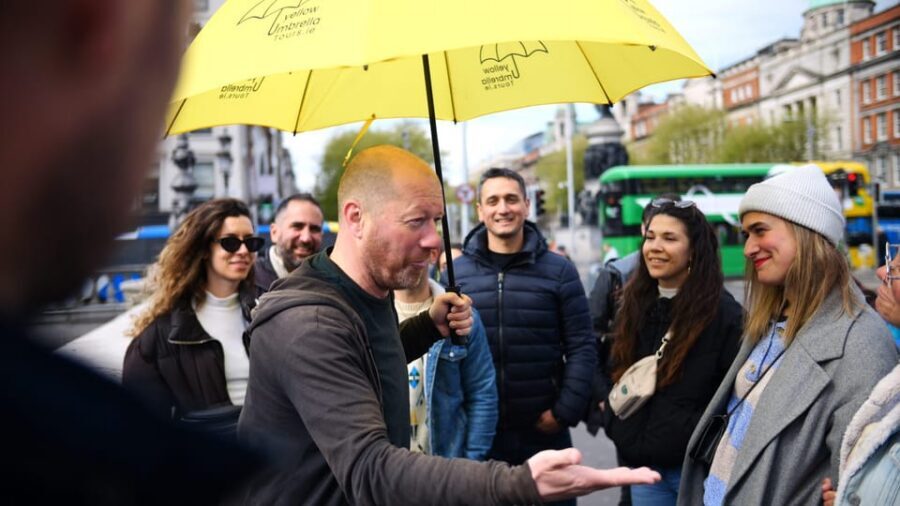
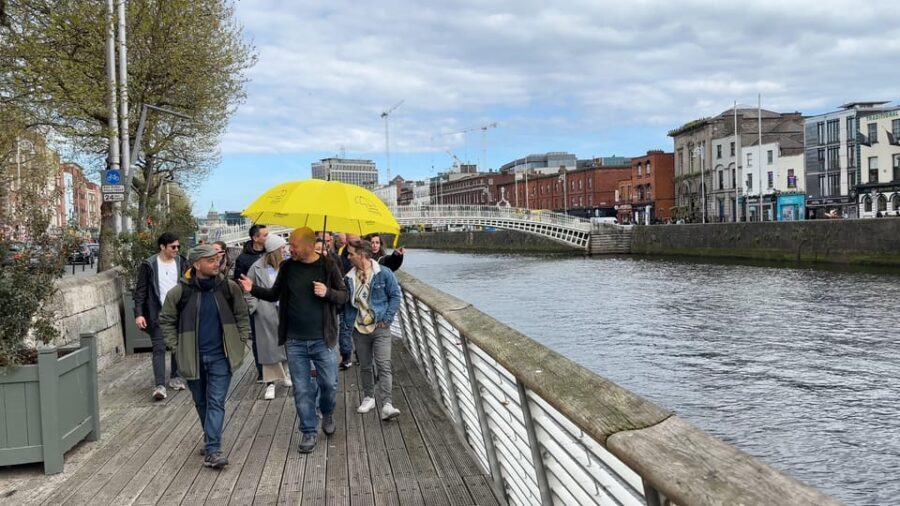
You cross back toward the north side views with stops that help you connect Dublin’s layers. The tour includes a view corridor that links the original Celtic settlement from about 2,100 years ago up to the Silicon Docks, inspired by American influence in the 21st century.
That jump in time is exactly what walking tours can do best, because your feet literally move you between eras. It also gives you a helpful mental map for the rest of your trip: you can see where the ancient core sits, and where newer Dublin built its modern identity.
As you head back over the Ha’Penny Bridge and through Merchant’s Arch onto Crown Alley, the tour calls attention to Central Plaza and specifically mentions Sam Stephenson’s brutalist behemoth. Brutalist architecture isn’t everyone’s taste, but the guide’s inclusion makes sure you’re not just passing it. You learn to recognize the style and understand why it feels so different from the cathedral-and-castle world.
College Green and the government-and-finance vibe
Next is College Green, where you’re rewarded with some of the finest neoclassical Georgian architecture. The tour frames this as the centre of government and finance for a city that once considered itself the 2nd city of the empire.
Even if you don’t care about architecture labels, this stop gives you a sense of how Dublin’s power shifted over time. Early power was tied to rule and religion. Later, it also took on the look of formal government and financial authority. College Green helps you connect those ideas to what you’re seeing.
Take a moment here to slow down and look around rather than just at one building face. Georgian streets and squares make more sense when you get a sense of how they work together as a group.
Molly Malone to Trinity College: finishing with Dublin’s most famous book
Before the tour ends, you’ll get a hello from Molly Malone outside St. Andrew’s Church. This is one of those playful cultural stops that keeps the tour from becoming only stone and politics. It also helps you remember that Dublin’s story includes the folk icons people repeat through generations.
Then you finish at the front gate of Trinity College, home of the Book of Kells exhibition. Even if you don’t go in right that minute, knowing this is where it’s housed gives the tour an obvious next step. It’s a strong ending point because Trinity is one of the city’s most recognizable academic landmarks.
Also, the tour ends back at the meeting point. That is nice because you don’t feel stranded in a far corner of the city after two hours.
Price and how $19 turns into real value
At $19 per person for a 2-hour guided walking tour, the value is in what you avoid. You avoid the guesswork of trying to piece together Dublin’s timeline alone, and you avoid the awkward feeling of seeing buildings without understanding why they matter.
The tour also gives you small, useful extras that add up: the guide can answer questions, adapt the tour to English level, and offer tips for the rest of your stay. When a guide is doing that well, the price stops feeling like a sightseeing fee and starts feeling like an investment in your whole day in Dublin.
And since the tour is only two hours, it fits neatly for visitors on tight schedules. If you land in Dublin and want a fast orientation that still feels meaningful, this is a strong option.
Who this tour is perfect for
This tour is a great fit if you want the big Dublin sights in a short time and you care about understanding what you see. It’s also ideal for first-timers who don’t want to spend hours researching and mapping on day one.
If you’re traveling with limited time but want a walk that connects cathedrals, political history, and modern references like the Silicon Docks, you’ll like the structure. If you’re mainly craving nightlife, you might find Temple Bar only as a slice of the evening, but the tour can still help you place that nightlife in its older street setting.
It’s also wheelchair accessible, which is important for visitors who want a walking tour format without leaving some people behind.
Should you book this Dublin bucket list walking tour?
I’d book it if you want a tight, guided route through Dublin’s most important landmarks with clear explanations and a guide who answers questions. The standout strength here is the way the tour turns each stop into a chapter—Viking beginnings, cathedral identity, British rule and the 1922 handover, Tudor-era streets, and the bridge to modern Dublin.
Skip it only if you hate moving quickly between stops, or if you’re someone who prefers long, slow museum time over guided city storytelling. With two hours, this tour is made to set you up for the rest of your trip, not replace it.
If your plan includes seeing Trinity College and the Book of Kells exhibition, this tour gives you an especially satisfying foundation before you go.
FAQ
How long is the Dublin Bucket List Sights Walking Tour?
It lasts about 2 hours.
What is the price per person?
The tour costs $19 per person.
Where do I meet the guide?
Meet the guide across the road from Christchurch Cathedral, outside the Bull and Castle.
How do I know I’m meeting the right guide?
Look for the yellow umbrella.
What sights are included?
You’ll see Christchurch Cathedral, St. Patrick’s Cathedral, Dublin Castle, Temple Bar, and finish at Trinity College (Book of Kells exhibition location).
What language is the tour guide?
The live tour guide speaks English.
Is this tour wheelchair accessible?
Yes, the tour is wheelchair accessible.
Where does the tour end?
It ends back at the meeting point.
Are there options for flexible booking?
Yes. You can reserve now and pay later, and you can cancel up to 24 hours in advance for a full refund.