REVIEW · DUBLIN
A Unique and Fun 1 Hour city tour of Dublin
Book on Viator →Operated by Experience in Motion · Bookable on Viator
One hour, Dublin, and you feel in charge. I like that this electric pedal cab tour is steered by a private driver, so you skip the long walks and still get close views, plus in-cab audio that helps you understand the places as you pass them. You also get a warm blanket, which sounds small until Dublin’s wind shows up.
The main trade-off is time. Since it’s about 1 hour, you get look-and-photo moments rather than long stays or inside visits, so it’s best when you want orientation and stories, not a full day of sightseeing.
In This Review
- Quick highlights I’d bookmark before you go
- The real reason this 1-hour Dublin tour feels useful
- Starting at College Green: Dublin’s “front door” for big moments
- Trinity College Dublin: prestige you can feel from the curb
- Oscar Wilde and Merrion Square: the literary Dublin stop
- Dublin’s seat of power (and the Irish government setting)
- Pepper Canister Church and the Grand Canal: Dublin’s music side
- Fitzwilliam Square: Georgian street time travel
- Stephen’s Green: where the parks story gets medieval
- Grafton Street: Dublin’s pedestrian shopping spine
- Ship Street Great and Forty Steps: medieval and Viking-era Dublin
- St Patrick’s site and Christ Church Cathedral: two big ages in one ride
- Dublin Castle: seeing power from two angles
- Price and value: why $40.12 can make sense in one-hour Dublin time
- Best fit: who should book this tour
- Should you book this 1-hour Dublin electric pedicab tour?
- FAQ
- How long is the Dublin city tour?
- What does the tour include?
- Is pickup available?
- Where does the tour start?
- Is this a private tour?
- How many landmarks do we see?
- Are mobile tickets used?
- Are admission tickets required for stops?
- Are service animals allowed?
- What is the cancellation policy?
Quick highlights I’d bookmark before you go

- 1 hour, 15+ landmarks: A tight route built for momentum and quick photo stops
- Private driver focus: You can ask questions and get personal attention as you go
- Electric and low-effort: A pedal cab powered for a smoother, more sustainable city glide
- Warm blanket comfort: Practical touch for cool days or breezy streets
- In-cab audio: Explanations as you roll past College Green, Trinity, and the cathedrals
- Built for first-timers and mobility needs: Much less walking than the classic loop
The real reason this 1-hour Dublin tour feels useful
Dublin has a way of confusing first-time visitors. Streets twist, neighborhoods overlap, and the main landmarks don’t always line up neatly if you’re on foot. This tour helps you get oriented fast by giving you a simple framework: you move through the city center in a straight line of “here’s what this place is” and “here’s why it matters.”
The electric pedal cab changes the pace in a good way. You’re not stuck behind a big bus wall, and you’re not fighting crowds at every corner. You’re also not constantly recalculating routes. In practice, that means more time watching details—doors, facades, statues—rather than just trying to arrive somewhere.
And the private-driver setup matters. Even when your route is shared with traffic, you can still have a conversation, ask questions, and get real-time help with what to notice next. One review mentioned the chance to pull over and chat, and that’s exactly the point: it makes the stories feel less like a lecture and more like a conversation with Dublin.
You can also read our reviews of more city tours in Dublin



Starting at College Green: Dublin’s “front door” for big moments
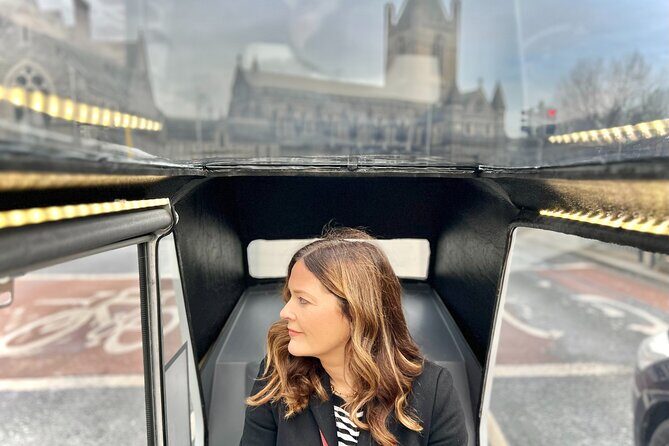
Most tours start with a bang, but College Green is a smarter kind of start. You begin at the city heart, and the area makes it easy to connect architecture to modern life.
From here, you’ll see the old Irish Parliament building—now a Bank of Ireland branch—and you’ll get why this area still hosts major events. St Patrick’s Day parade energy happens in the same general space, and it helps to be introduced to Dublin’s power centers before you wander off into smaller streets later.
What I like: You get context immediately. College Green gives you a baseline for what counts as important in Dublin—politics, culture, ceremony—so later stops land with more meaning.
Watch-out: Because you start in a busy zone, you’ll want to be ready to move quickly when the cab rolls out. It’s not a problem, just a reminder that city-center boarding happens fast.
Trinity College Dublin: prestige you can feel from the curb

Trinity College Dublin is famous, but it’s also easy to miss if you’re only passing by. On this tour, you get a perspective that’s less about entering and more about appreciating scale.
You’ll glide in views that let you sense how the institution sits in the middle of the city. The tour frames it as part of Ireland’s long “saints and scholars” story, which is an angle that helps you connect Trinity to everything around it instead of treating it like a standalone postcard.
The practical win: If you’re short on time, you still get a real orientation to one of Dublin’s most recognizable anchors—without adding the stress of lines, ticket decisions, and crowd flow.
Oscar Wilde and Merrion Square: the literary Dublin stop
Next up is Oscar Wilde’s world. You’ll pass the statue at Merrion Square, tied to the poet and playwright who grew up in Dublin and whose home has been lovingly maintained. The statue being made with different colored marble is the kind of detail that’s easy to overlook when you’re just walking past.
Merrion Square itself matters too. It’s a public park that locals actually use, and the Georgian architecture around it is a strong example of why Dublin’s layout feels intentional. The tour skims the edge of the square, giving you a good “frame” for photos and for noticing the rhythm of Georgian doors and facades.
My advice: If you care about literature and Dublin’s creative identity, take one minute here to slow down and look. The statue and the square are small compared with bigger attractions, but they give the city a human face.
Dublin’s seat of power (and the Irish government setting)

At one point you’ll pass a magnificent Georgian manor house described as the Irish government’s home today, formerly associated with the Lord Lieutenant of Ireland. Even if you don’t plan to go inside, the cab view helps you connect government power to the buildings you’ll keep seeing in the city center.
This kind of stop is more than sight-seeing. It’s what makes the rest of your Dublin day make sense. If you’ve ever felt like Irish history is all names and dates, seeing where that power sits in brick-and-stone helps it click.
Consideration: This is a moving-view experience. Don’t expect a long explanation on one doorstep; the value is how many meaningful anchors you get in one hour.
A few more Dublin tours and experiences worth a look




Pepper Canister Church and the Grand Canal: Dublin’s music side
Before you reach the Grand Canal, you’ll see the Pepper Canister Church. It’s named for the shape of spice containers around the time of construction, and it’s now used for musical performances. That detail is more than trivia. It hints at Dublin as a city where faith, architecture, and music all overlap.
From the cab, you’ll get a view right at the intersection, with Georgian buildings framing the church. It’s one of those spots where a quick pull-over for a photo is exactly right—you don’t want to spend ten minutes searching for the perfect angle. The tour is designed to give you the angle.
Then comes the Grand Canal, one of Dublin’s best “walk or linger” areas. The tour’s canal stop ties into Patrick Kavanagh, pointing you to his statue and noting his poem Grand Canal Walk. Even if you’re not getting out for a full stroll, you’ll understand why the canal is a constant backdrop in Dublin life.
What’s especially good here: Dublin’s canals feel alive in a low-key way. You’ll see people milling about, and that gives you a different Dublin than cathedrals and castles. It’s contrast, and contrast is what makes a short visit feel complete.
Fitzwilliam Square: Georgian street time travel
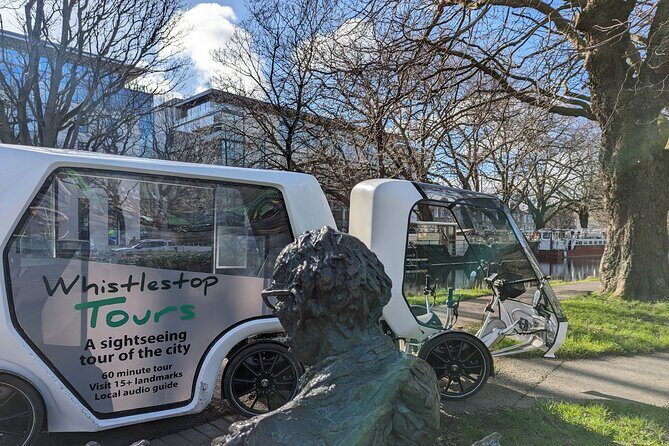
Fitzwilliam Square is reached after a shift from modern offices back to older Georgian Dublin. Fitzwilliam Street is described as one of the longest Georgian streets in the world, and the cab angle makes that scale easier to appreciate.
Then you arrive at Fitzwilliam Square, described as the smallest of Dublin’s squares. That matters because small doesn’t mean insignificant. The square design and Georgian facades are the point—this stop helps you notice Dublin’s planning logic: squares as social spaces, streets as stages, architecture as identity.
Photo tip: Use this stop to focus on details. Georgian Dublin isn’t only about the big view; it’s about doors, windows, and the way buildings line up.
Stephen’s Green: where the parks story gets medieval
Stephen’s Green is one of the most beloved parks in Dublin, and the tour frames it as the biggest and grandest of the Georgian squares. You’ll also hear a fun trivia thread: it was home to Arthur Guinness and Grace Kelly—not at the same time, of course, but the juxtaposition helps you remember how far Dublin’s reach has stretched.
The tour also points toward medieval origins of the surrounding streets. That’s helpful because Stephen’s Green isn’t just a pretty park stop. It’s a place where layers of time overlap, from medieval roots to Georgian planning.
Small practical plus: A park stop is a relief from constant city traffic. Even if you’re staying seated in the pedicab, you get a visual reset.
Grafton Street: Dublin’s pedestrian shopping spine
Next you head into Dublin’s main shopping street, Grafton Street. Since it’s pedestrianized, it’s a street many tours can’t handle the same way. Here, your cab keeps things practical and gives you time to explore nearby streets too.
The tour frames Grafton Street as a place mentioned in songs, stories, and poems for generations. That’s the right angle for travelers who don’t just want shopping—they want cultural context while they walk.
What to do with your time: If you want souvenirs, snacks, or a quick coffee, this is the logical moment. If you want photos, treat this as your “street life” stop—watch people, watch movement, and capture that Dublin feel that doesn’t come from monuments alone.
Ship Street Great and Forty Steps: medieval and Viking-era Dublin
Once you leave the Georgian areas, the mood shifts. You go back further in time through cobblestone streets to some of Dublin’s oldest medieval sections.
You’ll hear about why Vikings chose to build a city here and even the origin of the name Dublin. That’s the kind of story that’s hard to track if you’re bouncing between landmarks on foot. The cab makes it easier because you keep moving as the history changes.
Then there’s a photo opportunity at Forty Steps—a less famous stop that’s still exactly the kind of detail that makes Dublin feel real. You’ll also see an impressive remaining section of Dublin’s historic defensive walls.
Why it works: These are the places where “dublin is old” becomes specific. Instead of a generic ancient-country feeling, you see the physical evidence of how the city defended itself.
St Patrick’s site and Christ Church Cathedral: two big ages in one ride
You’ll then move to the religious heart of the story, starting at the site associated with St Patrick’s first Christian conversions in Ireland. The tour notes that claims about driving snakes out are pretty dubious, but St Patrick is still presented as the key figure behind bringing Christianity and ushering in a golden age.
This stop is also about naming. The tour connects the Land of Saints and Scholars idea directly to this area and then points you to a cathedral named after him on the same important site. Even if you don’t go inside, you’ll understand why this site is central to Irish identity.
From there, you reach Christ Church Cathedral. This is described as older than St. Patrick’s Cathedral, with a church on the site for around a thousand years. The cab view gives you both history and a sense of scale—Christ Church feels like it has a long memory.
Consideration: Religious sites can be emotionally powerful, but in one hour, you’re not getting long reflection time. If you want quiet, plan to return later, but for orientation and context, this sequence is strong.
Dublin Castle: seeing power from two angles
Dublin Castle is your final major history anchor before you return. It’s described as the seat of British rule in Ireland for over 700 years and also the place where Ireland gained independence.
You’ll see the castle from two different angles during the tour, which is a smart move. Castles can look similar from one direction. Two angles help you understand massing, position, and how the castle sits in the broader city fabric.
Then you head back to your starting point, and the tour ends where it began—useful because you’ll likely continue your own day from College Green.
Price and value: why $40.12 can make sense in one-hour Dublin time
At $40.12 per person for an approximately 1-hour experience, the price lands in the mid-range for a guided city activity. The real question is value: what do you gain for paying instead of DIY walking?
You’re paying for three things that are hard to replicate on your own in a short window:
- Time saved by skipping long walking and using a cab designed for quick city movement
- Interpretation via in-cab audio that explains why each stop matters
- Comfort and access through low-effort movement and a warm blanket, which helps on cool days
It’s also a tour with strong demand. It’s booked about 183 days in advance on average, which usually means people are planning ahead and treating it as a “must-do first day” kind of activity.
Who this price works best for: first-timers, couples who want a guided intro without a huge commitment, and anyone who wants to cover a lot of ground while still keeping the day flexible.
Best fit: who should book this tour
This tour is a great match if you:
- Have only about a day in Dublin and want a fast, story-led orientation
- Prefer less walking but still want meaningful stops
- Like photo opportunities with enough time to pause
- Want an easy first “arc” through Dublin’s Georgian, medieval, and cathedral-era parts of town
It’s less ideal if you want long museum-style visits or you’re aiming to spend an hour inside big attractions. Think of it as your guided shortcut to understanding the city, then you pick your favorites afterward.
Should you book this 1-hour Dublin electric pedicab tour?
Yes, if you want a short, structured intro that still feels personal. The private driver setup, in-cab audio, and photo-friendly stop style make it a practical way to see a lot without wearing yourself out.
I’d skip it only if your travel goal is deep, slow exploration at a handful of sites. For first-day orientation, or for traveling with mobility limits, this is the kind of tour that turns Dublin from confusing to clear quickly.
FAQ
How long is the Dublin city tour?
The tour lasts about 1 hour.
What does the tour include?
You ride in an electric pedal cab with a private driver and in-cab audio. You also receive photo opportunities along the way and a warm blanket.
Is pickup available?
Yes. Pickup is offered.
Where does the tour start?
The meeting point is Starbucks College Green1 College Green, Temple Bar, Dublin, D02 YT92, Ireland.
Is this a private tour?
Yes. It’s a private tour/activity, and only your group participates.
How many landmarks do we see?
The tour is described as seeing more than 15 top landmarks in just 1 hour.
Are mobile tickets used?
Yes. Mobile ticketing is included.
Are admission tickets required for stops?
The itinerary notes free admission at multiple stops. Specific sites are listed with admission ticket free.
Are service animals allowed?
Yes, service animals are allowed.
What is the cancellation policy?
Free cancellation is available. You can cancel up to 24 hours in advance for a full refund.