REVIEW · GALWAY
Galway History Walking tour with Local expert – Private Group
Book on Viator →Operated by Western Tours and Tales · Bookable on Viator
Galway’s street stories hit fast on foot. I love that this is a private Galway history walk led by a local guide who points out the details most people miss, and I love that it includes a St Nicholas Collegiate Church visit with a voucher. The only drawback: it’s mainly outdoors, so you’ll want good weather and a willingness to walk.
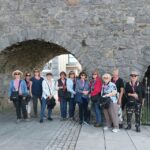
I like the feel of this tour because it starts right in the action—at the Hardiman Hotel on Eyre Square—and it brings you back there when you’re done. With a group size capped at up to 13, it still feels personal, and you can usually ask questions without shouting over the streets.
In This Review
- Key things I found most useful
- Why this Galway history walk feels local (not museum-y)
- Starting at the Hardiman Hotel: Eyre Square in plain sight
- Williamsgate Street and the Oscar Wilde statue moment
- Eglinton Street to Courthouse Square: buildings with consequences
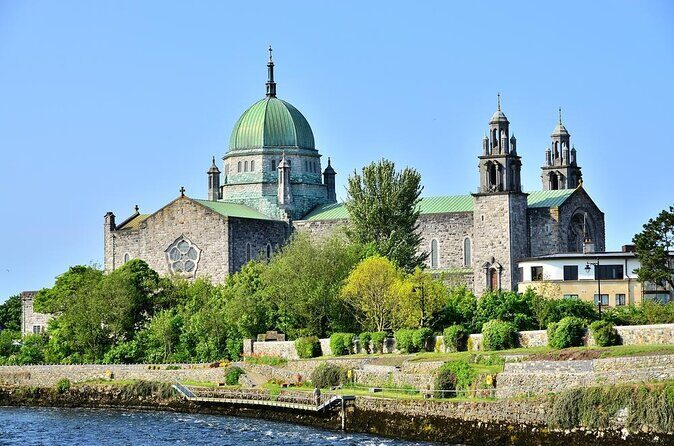
- River Corrib and Galway Cathedral: a modern landmark with old echoes
- Lynch’s Castle and Market Street: power, funerals, and symbols
- The Lynch Memorial window and the Bowling Green Joyce link
- Saint Nicholas Collegiate Church: the “included” moment you’ll remember
- High Street’s Latin Quarter: pubs, MPs, and Cromwell-era lore
- Spanish Parade and the old port area: Spain to Galway by ship
- Red Earl ruins to Druid Theatre to An Taibhdhearc: culture in three quick stops
- Abbeygate Street Lower: the former cathedral building and Dr Michael Browne’s decision
- Is $150.60 worth it? A real value check for a private group
- Practical tips so the tour goes smoothly
- Should you book this Galway private history walking tour?
- FAQ
- How long is the Galway history walking tour?
- Where does the tour start and end?
- How much does the tour cost?
- Is the tour a private group?
- Is the tour in English?
- What’s included regarding St Nicholas Collegiate Church?
- Are any admissions required at stops other than St Nicholas?
- What guided-tour times are mentioned for St Nicholas?
- What if the weather is bad?
- Can you cancel for free?
- Is the tour accessible for people with mobility issues?
Key things I found most useful
- Eyre Square orientation first, with specific landmarks like the Browne Doorway, the Tribes of Galway banners, and the Kennedy memorial
- St Nicholas Collegiate Church included, plus a voucher for the right timed visits
- A route built around lesser-seen streets, like Church Lane (Dead Man’s Lane) and the Market Street approach
- Big-name stories in small places, from James Joyce and Bloomsday to Oliver Cromwell’s connection to the King’s Head Pub
- Architecture spotting throughout, including Lynch’s Castle, Galway Cathedral, and the Red Earl site
- Flexible pacing for your group, including an option for a shorter version with mobility needs
Why this Galway history walk feels local (not museum-y)
This tour works because Galway’s old stories are tied to exact corners, doorways, and buildings. Instead of dumping dates on you, the guide makes you look—at carvings, symbols, burial grounds, and the street names that survived for a reason. You’ll finish with a mental map of the city, so wandering afterward feels easier.
The private-group format matters too. A tour for up to 13 still lets the guide adapt—different families, different interests, and different question styles. In practice, that means you’re not stuck with a one-size script. If you’re traveling with kids, this kind of pace and conversation tends to land well.
One more practical point: the tour is built around stops that are mostly free to visit. The only paid/“included” element is the St Nicholas Collegiate Church portion, which keeps your budget calmer than tours that stack admissions back-to-back.
You can also read our reviews of more walking tours in Galway


Starting at the Hardiman Hotel: Eyre Square in plain sight
You meet at the front entrance of the Hardiman Hotel in Eyre Square. That’s a smart start: Eyre Square is easy to reach, and it gives you a central reference point for everything you’ll see later.
From there, you get a quick orientation of how Galway “ticks.” The guide points out standout features around the square, including the old Browne Doorway and the Tribes of Galway banners—plus visible connections to famous names like John F. Kennedy. You also hear about the Quin-centenary Fountain and the O’Connaire statue, which are easy to walk past without knowing why they’re there.
A nice touch here is how the guide blends the local with the global. Eyre Square becomes a launchpad for understanding why Galway drew attention from far beyond Ireland.
Williamsgate Street and the Oscar Wilde statue moment
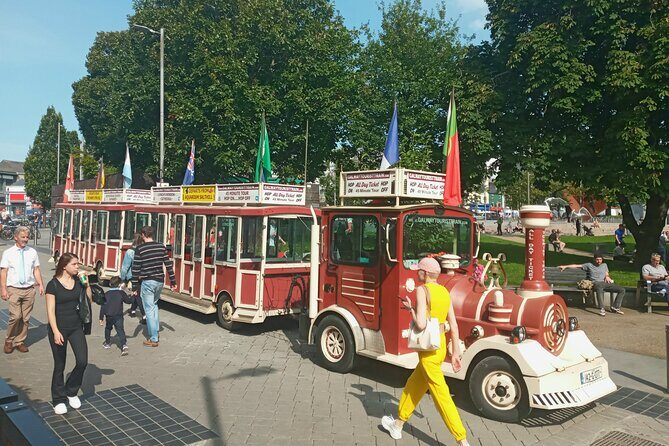
After Eyre Square, you shift toward Williamsgate Street, where the tour slows just enough to notice the layers of the streets. You pass notable buildings, including the Browne Thomas building, and you’ll spot shopfront details connected to Galway’s famous jewelry culture—especially the Claddagh ring.
If timing allows, there’s also a stop near the Oscar Wilde statue, described as an Estonia gift to Ireland in 2004. It’s the kind of quirky, specific fact that makes the city feel lived-in rather than postcard-perfect.
This section is short on purpose. It keeps you moving while still giving you a chance to absorb the visual style of the streets.
Eglinton Street to Courthouse Square: buildings with consequences
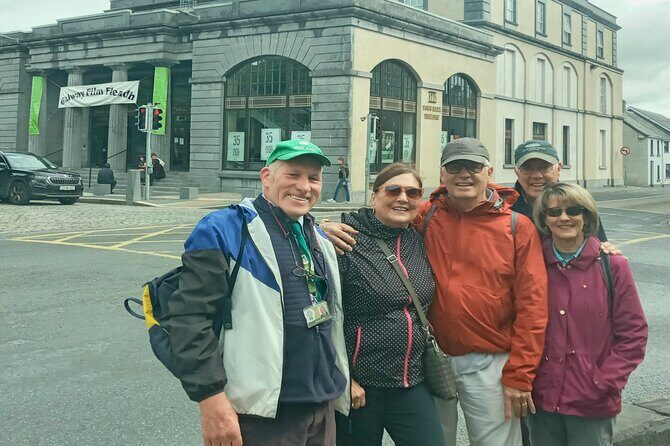
Next you divert down Eglinton Street, where you pass the Franciscan Friary on the left. The guide points you toward the small graveyard at the rear, which was an important burial place in the mid-17th and early 18th centuries.
That’s one of the tour’s strengths: it doesn’t treat churches like scenery. It frames them as places where real social life happened—where community, religion, and politics overlapped.
Then you head toward Courthouse Square. The tour explains that there used to be two courthouses (county and city), and only one remains today. The Town Hall Theatre sits opposite, so you get a clear sense of how the “law and governance” story evolved in the city center.
If you like understanding why things are where they are, this middle stretch is a good payoff.
River Corrib and Galway Cathedral: a modern landmark with old echoes
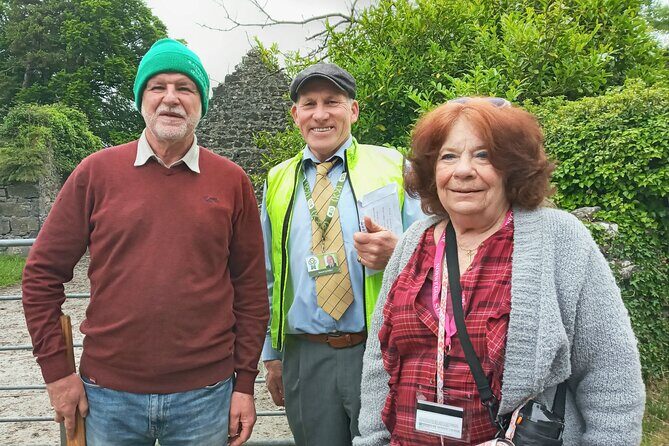
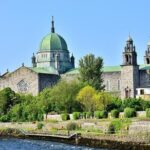
You pause near the pedestrian bridge over the River Corrib to view Galway Cathedral—called Europe’s newest stone cathedral—along with the Franciscan Chapel. Even if you’re not a cathedral person, this stop gives you a visual reset. You get open lines of sight across the river area, then you’re back into tight streets.
The guide keeps it grounded: you see what’s new, but you’re still learning how Galway’s religious story has changed over time.
This stop is also a weather checkpoint. If it’s windy or drizzly, you may want to keep your outer layer handy and avoid anything too slippery underfoot.
You can also read our reviews of more private tours in Galway



Lynch’s Castle and Market Street: power, funerals, and symbols
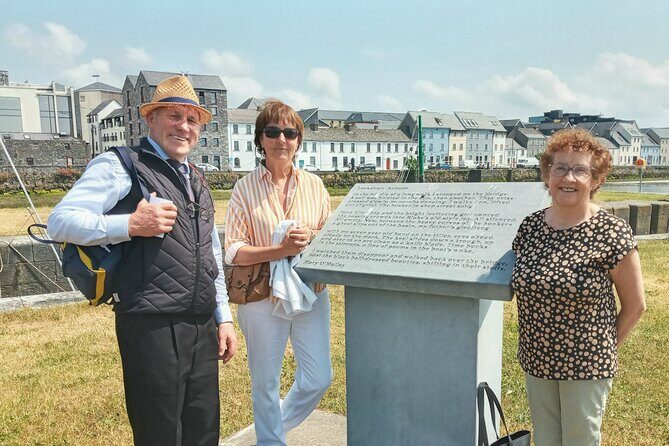
When the tour returns via the River Walk, you arrive at Lynch’s Castle at a two-street intersection. This is one of the bigger “wow” buildings on the route. It’s described as the finest surviving town-castle in Ireland, tied to the powerful Lynch clan.
The guide goes beyond the façade and talks about crests and roundels. That matters because you start seeing decorative elements as historical clues, not just design.
From there you turn through Church Lane, once called Dead Man’s Lane, where funerals would pass on the way into the old graveyard. It’s an eerie name, but hearing it in context makes the city feel honest. You’re seeing how daily life worked when travel was harder and death was more public.
Then you continue into Market Street, where the guide connects you to the story behind the St Nicholas church-yard and why this area had such long-term importance.
The Lynch Memorial window and the Bowling Green Joyce link
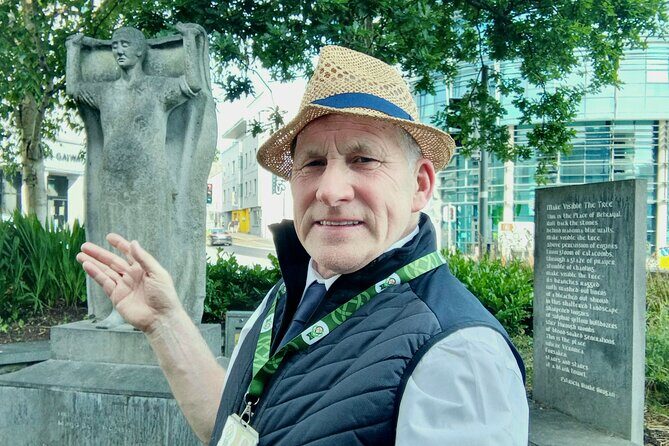
In this section, you’ll encounter the Lynch Memorial window erected in 1854, along with its legend: Mayor Lynch is said to have hanged his own son at this location. Whether you treat it as folklore or history, the point is how personal tragedy and civic power get woven into Galway’s landmarks.
Right nearby, the tour routes close to Bowling Green, described as the family home of Nora Barnacle. The guide shares her link to James Joyce—their date on 16 June 1904, after which the day became known as Bloomsday.
This is one reason I think the walk fits many types of visitors. Even if your main goal is architecture, you’ll still get story fuel from literature and famous names.
Saint Nicholas Collegiate Church: the “included” moment you’ll remember
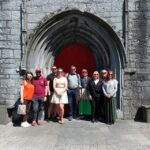
You arrive at Saint Nicholas Collegiate Church with your guide, and this is the key stop that’s truly built into the cost. The guide explains why it’s important: it’s the largest Medieval church in continuous use in Ireland. The tour also notes the shift in use over time—built originally as a Catholic church, and today it functions as a Protestant church.
One of the more unusual details you’ll hear is that Christopher Columbus is said to have worshipped here in 1477. Even if you keep a skeptical hat on, it’s a fun detail—and it connects Galway to a wider world.
Inside, you’ll see that there’s plenty to take in. You’re also offered discounted tickets to join guided tours that operate:
- Mon–Fri at 11am and 2pm
- Wednesdays at 12pm and 3pm
The voucher included in the tour applies to 10am and 1pm tours only, so if you’re booking for a specific day, it’s worth aligning your plans with those times.
This stop is also where the guide’s style shines. Reviews reflect how guides stayed friendly and flexible—especially when weather turned rough. If it’s raining, you’ll at least get a solid indoor anchor to your walking time.
High Street’s Latin Quarter: pubs, MPs, and Cromwell-era lore
Next you move into Galway’s Latin Quarter, centered around High Street. This is where the city’s storytelling gets playful.
You’ll pass the King’s Head Pub, with a legend that the site was gifted by Oliver Cromwell as payment to the executioner of King Charles I. You’ll also hear about Naughton House, once owned by Humanity Dick Martyn, an Irish MP in the British Parliament.
It’s a sharp reminder that Ireland’s story isn’t one straight line. It’s a messy overlap of politics, trade, and power—some of it brutal, some of it political theater, and plenty of it stuck in place through buildings that are still standing.
If you want a walking tour that includes literature and political connections without feeling heavy, this stretch is a strong one.
Spanish Parade and the old port area: Spain to Galway by ship
You reach the Spanish Parade, an open space that once contained the old Galway port until 1840. The guide explains how ships from Spain arrived here bringing wines and spices for merchant families.
Right adjacent is the Spanish Arch, and the tour uses it to show how trade geography shaped what Galway became. It’s easy to treat these as pretty structures. Here you learn to treat them like evidence of real commercial links.
For me, this is where Galway feels like a coastal city again—even though you might not be thinking about ports when you’re in the middle of the streets.
Red Earl ruins to Druid Theatre to An Taibhdhearc: culture in three quick stops
The tour loops back toward the medieval site of the Hall of the Red Earl. You’re shown the ruins, tied to the Norman Richard de Burgo, and you learn that they weren’t always visible—archaeologists discovered them in the late ’90s.
Then you keep moving toward Druid Theatre, founded in 1975 by university graduates. The guide shares that Druid has maintained a relationship with writers Tom Murphy and Martin McDonough. You also hear that many known Irish actors and directors have worked with the company over the years.
A few steps later, you pass An Taibhdhearc, Ireland’s only Irish-language theatre. The tour frames it as part of a cultural push after Ireland became a Free State in the early 1920s, and mentions Micheal MacLiamor as the first director/manager working there from 1928.
This section is short, but it changes the tone of the tour from “old Galway” to “Galway now.” If you’re planning where to spend evenings later, you’ll have a few cultural bookmarks in your head.
Abbeygate Street Lower: the former cathedral building and Dr Michael Browne’s decision
The last stretch takes you to a former cathedral building near Middle Street / Abbeygate Street Lower, described as a Gothic and Tudor Revival-style structure. The tour explains that it was in use for many centuries, then deemed inadequate by Galway bishop Dr Michael Browne in 1957.
The route also mentions the Augustinian Order, arriving in Galway in 1500 and setting up an abbey in the Forthil. It notes that Oliver Cromwell’s army banished them for a period, but they returned in 1760 and established this building.
This ending makes the tour feel complete. You see the religious story not as a single chapter, but as a long, shifting one that keeps reappearing in stones and street locations.
Is $150.60 worth it? A real value check for a private group
The price is $150.60 per group, with a group size up to 13 people, and the tour runs about 1 hour 55 minutes. That pricing structure can be a good deal if you’re traveling with a few people, because you’re not paying per person for every minute.
You’re getting:
- A professional guide for nearly two hours
- A route with many free-to-access stops
- The included voucher component for Saint Nicholas Collegiate Church
- A private-group feel without going to the hassle of renting a car
To decide if it’s a good value for you, think about what you want from your Galway time. If you like street-level stories, architecture details, and a guided orientation that helps you plan the rest of your stay, this usually pays off fast. If your ideal trip is more about museums, galleries, or long indoor experiences, you may want a more museum-heavy day.
Also, note that this tour has you walking through the city center. Wear shoes you don’t mind breaking in. You’re not just sitting in a van with a microphone.
Practical tips so the tour goes smoothly
- Arrive a few minutes early at the Hardiman Hotel front entrance. Meeting points are small and the streets around Eyre Square can be busy.
- Bring a light rain layer anyway. The experience requires good weather, but if conditions change, you’ll still want to be ready for indoor time at St Nicholas.
- Use the guide’s personalization. The tour can be adapted to guest wishes, and guides often tailor by interests and group needs. If you care about Joyce, ask about Nora Barnacle and Bloomsday as you pass Bowling Green.
- Ask one “why does it matter” question per stop. Eyre Square, Spanish Parade, and Lynch’s Castle are all places where a good question turns sightseeing into understanding.
- Plan your St Nicholas timing. The guided-tour discounts have specific operating times, and the voucher targets 10am and 1pm tours.
Should you book this Galway private history walking tour?
Book it if you want a city orientation that feels like a conversation, not a lecture. The route hits key landmarks—Eyre Square, Lynch’s Castle, the Latin Quarter, Spanish Parade, and St Nicholas Collegiate Church—while still including the kinds of streets and stories most people skip. I also like that the format is private and can be adapted, which helps if your group has different interests or questions.
Skip it if you dislike walking or if you prefer fully indoor attractions. It’s designed for streets, doorways, and the slow work of noticing details. If the weather is awful, you’ll likely lose some of the outdoor rhythm.
If you fit the middle—curious, comfortable on foot, and excited by real place-based stories—this is a strong way to start (or deepen) your Galway stay.
FAQ
How long is the Galway history walking tour?
It runs for about 1 hour 55 minutes.
Where does the tour start and end?
It starts at the front entrance of the Hardiman Hotel in Eyre Square, Galway, and ends back at the meeting point.
How much does the tour cost?
It costs $150.60 per group, up to 13 people.
Is the tour a private group?
Yes. It is private, and only your group participates.
Is the tour in English?
Yes, it’s offered in English.
What’s included regarding St Nicholas Collegiate Church?
The tour includes a voucher toward a visit to Saint Nicholas Church, for the 10am and 1pm tours only.
Are any admissions required at stops other than St Nicholas?
All other stops listed are marked as free admission. Saint Nicholas’ church stop is the included ticket/voucher component.
What guided-tour times are mentioned for St Nicholas?
Guided tours operate Mon-Fri at 11am and 2pm, and on Wednesdays at 12pm and 3pm.
What if the weather is bad?
The experience requires good weather. If it’s cancelled due to poor weather, you’ll be offered a different date or a full refund.
Can you cancel for free?
Yes. Free cancellation is available if you cancel up to 24 hours in advance for a full refund.
Is the tour accessible for people with mobility issues?
A shortened version of the city tour can be offered for guests with mobility issues, and plans are in place to deal with emergencies. Service animals are allowed.